RRSP GUIDE
The RRSP Deadline Just Passed — Here’s What to Do Next
A practical, no-jargon guide to RRSP contribution strategy, CRA rules, and how the RRSP compares to the TFSA.
Budgeting Tips Canada · March 2026
If the RRSP deadline caught you off guard this year, you’re not alone. Every February, millions of Canadians scramble to gather funds and make a last-minute contribution before the 60-day cutoff. Some manage it. Many don’t. And by March, most have moved on — until the same cycle repeats the following year.
This guide is designed to break that cycle. Whether you contributed this year or not, the steps you take now — starting in March — will have a far greater impact on your retirement savings than any last-minute February deposit ever could.
We’ll cover how RRSP contribution room works under CRA rules, the real trade-offs between contributing monthly versus in a lump sum, how the RRSP compares to the TFSA, and what a practical year-round contribution strategy actually looks like.
How RRSP Contribution Room Works
Your RRSP contribution room — also called your “deduction limit” — is not a fixed number. It accumulates each year based on your earned income from the prior year, and any unused room carries forward indefinitely.
The 2026 Contribution Limit
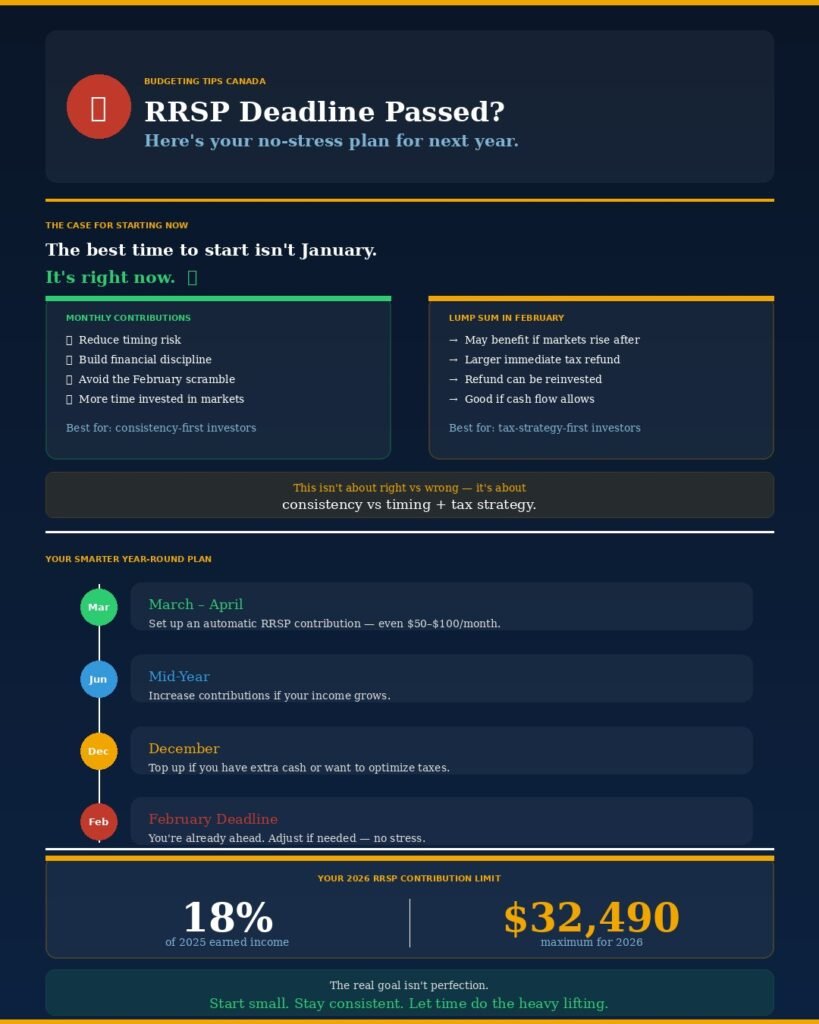
For the 2026 tax year, the RRSP rules are:
- Your new contribution room equals 18% of your 2025 earned income
- Subject to a dollar maximum of $32,490
- Plus any unused contribution room carried forward from previous years
“Earned income” for RRSP purposes is broadly defined by CRA and includes employment income, self-employment net income, rental income, royalties, and alimony received. It does not include investment income, pension income, or employment insurance benefits.
Example: If you earned $70,000 in 2025, your new 2026 RRSP room is $12,600 (18% × $70,000). If you also had $8,000 in unused room carried forward, your total available room would be $20,600.
How to Check Your Exact Room
The most reliable way to confirm your available RRSP room is through CRA My Account (canada.ca/my-cra-account). Your limit is also stated on your most recent Notice of Assessment — the document CRA sends after processing your tax return.
Your financial institution does not have access to your real-time contribution room. Always verify with CRA before making large contributions to avoid an over-contribution, which attracts a 1% per month penalty tax on amounts exceeding $2,000 over your limit.
The Contribution Deadline
RRSP contributions can be made at any time during the calendar year, or within the first 60 days of the following year. That 60-day window — which typically ends in late February — is what allows contributions made in January and February to be deducted on either the prior year’s or current year’s tax return.
Contributions made after the 60-day deadline apply to the current tax year only.
Monthly Contributions vs. Lump Sum: An Honest Comparison
Much of the advice you’ll find online presents this as a clear-cut choice. It isn’t. Both approaches have legitimate merits, and the right answer depends on your cash flow, tax situation, and investment philosophy.
The Case for Monthly Contributions
Contributing consistently throughout the year — rather than in a single February deposit — offers three distinct advantages:
- Time in market: Your money begins working earlier. In most market environments, earlier investment outperforms later investment over long time horizons, though this is directionally true rather than guaranteed.
- Dollar-cost averaging: Buying into the market at different price points throughout the year reduces the impact of any single period of volatility.
- Behavioural consistency: Automating contributions removes decision fatigue and builds savings discipline without requiring active effort.
Even small amounts make a meaningful difference. A $100 automatic monthly contribution starting in March adds up to $1,200 by February — without any last-minute scramble.
The Case for Lump Sum in February
The February lump sum strategy has real merits that are often dismissed:
- Tax refund leverage: A larger single contribution generates a larger immediate tax refund, which can then be reinvested — either back into the RRSP, into a TFSA, or toward other financial goals.
- Market timing optionality: If markets are depressed in late winter, a lump sum buys more units at a lower price.
- Bonus and year-end income: Some earners only know their final income — including bonuses and self-employment revenue — in January or February, making a year-end contribution more logical.
The honest framing: monthly contributions optimize for time in market and consistency; lump sum contributions optimize for tax strategy and flexibility. Neither is universally superior.
RRSP vs. TFSA: Which Should You Prioritize?
This is one of the most common questions in Canadian personal finance, and it’s one that depends heavily on your income level and anticipated retirement situation. The two accounts are not mutually exclusive — they serve complementary purposes — but if you can only fund one, the following comparison can help guide your decision.
| Feature | RRSP | TFSA |
|---|---|---|
| Contribution limit (2026) | 18% of earned income, max $32,490 | $7,000 (plus any unused room) |
| Tax treatment of contributions | Tax-deductible — reduces taxable income | Not deductible — contributions from after-tax dollars |
| Tax treatment of withdrawals | Fully taxable as income in year of withdrawal | Completely tax-free at any time |
| Withdrawal room restored? | No — room is permanently lost on withdrawal | Yes — restored the following calendar year |
| Best suited for | Higher earners expecting lower income in retirement | Any income level; flexible and penalty-free access |
| Spousal option? | Yes — spousal RRSP available for income splitting | No spousal equivalent |
| Deadline | 60 days after Dec 31 (late Feb) | December 31 of the calendar year |
| Unused room | Carries forward indefinitely | Carries forward indefinitely |
A Framework for Deciding
As a general rule of thumb used by many Canadian financial advisors:
- If your marginal tax rate today is higher than you expect it to be in retirement, the RRSP typically wins. The deduction saves you more tax now than you’ll pay on withdrawal later.
- If your income is low or you expect your retirement income to be comparable to your current income, the TFSA is often more flexible and equally effective.
- For middle-income earners, a blended approach — contributing to both — is frequently the optimal strategy.
A practical starting point: maximize your RRSP contribution room to the point where your refund drops you to the next marginal bracket, and direct the refund into your TFSA.
What a Year-Round RRSP Strategy Actually Looks Like
Rather than treating the RRSP as a once-a-year deadline event, the most effective approach treats it as an ongoing financial habit. Here’s how that maps to the calendar:
March – April: Set Up Automatic Contributions
The most impactful step you can take right now is setting up an automatic monthly RRSP contribution with your financial institution. You don’t need to start with a large amount. Even $50 to $100 per month builds the habit and adds to your time in market.
Choose a contribution date that aligns with your pay cycle — typically the same day your paycheque deposits — so the transfer happens before discretionary spending.
Mid-Year: Reassess and Adjust
By June or July, you’ll have a clearer picture of your year’s income trajectory. If you’ve received a raise, taken on additional work, or had a particularly strong quarter in your business, this is the right time to increase your monthly contribution amount.
It’s also a good point to log into CRA My Account and confirm your available room, particularly if you made any unplanned contributions or received a retroactive pay adjustment.
December: Year-End Top-Up
If you have surplus cash at year-end — from a bonus, tax refund, or lower-than-expected expenses — December is an appropriate time to make an additional lump sum contribution. This ensures the funds are working for you through the early months of the new year.
December is also the time to consider your overall tax position for the year and whether additional RRSP contributions would reduce your taxable income to a more favourable bracket.
February: Fine-Tuning, Not Scrambling
If you’ve been contributing throughout the year, the February deadline becomes a minor calibration point rather than a crisis. Review your total contributions, compare them to your available room, and make a small top-up if there’s room and cash available.
If you received a significant bonus or income event after January 1, the first 60 days of the year are also an opportunity to make a prior-year RRSP deduction.
How Much Can You Expect Back? Illustrative Tax Scenarios
The following table illustrates the approximate tax refund a single Ontario resident might expect from RRSP contributions at various income levels. These are estimates only — your actual refund depends on your full tax profile, other deductions, and credits.
| Scenario | Gross Income | RRSP Contribution | Est. Tax Refund (Ontario) |
|---|---|---|---|
| Low earner | $45,000 | $5,000 | ~$1,100 |
| Mid earner | $85,000 | $10,000 | ~$3,100 |
| Higher earner | $130,000 | $23,400 (18%) | ~$8,700 |
| Max contributor | $180,000+ | $32,490 (max) | ~$12,100 |
Note: Estimates based on 2025 federal + Ontario combined marginal rates for a single filer with no other deductions. Actual results will vary.
The Compounding Effect of Starting Early
The mathematical argument for early and consistent RRSP contributions is straightforward. Compound growth rewards time more than it rewards the size of any individual contribution.
Illustration: An investor who contributes $400/month starting at age 30 and earns a 6% average annual return will accumulate approximately $400,000 by age 60. An investor who waits until age 40 and makes the same monthly contribution at the same return rate will accumulate approximately $200,000 — roughly half — despite contributing for only one third fewer years.
The takeaway is not that perfection is required. A modest, consistent contribution habit started in your 30s will typically outperform a larger but irregular strategy started later. The RRSP’s tax-deferred growth environment amplifies this effect, since you’re not losing a portion of your returns to tax each year on dividends or realized gains.
Key Takeaways
- Your 2026 RRSP contribution limit is 18% of your 2025 earned income, up to a maximum of $32,490, plus any unused room carried forward.
- Always verify your exact room on CRA My Account or your Notice of Assessment before contributing.
- Monthly contributions and lump sum strategies each have merit — the right approach depends on your cash flow and tax situation.
- The RRSP provides a tax deduction on contributions and tax-deferred growth; the TFSA provides tax-free growth and flexible, penalty-free withdrawals. They serve different but complementary roles.
- The most effective RRSP strategy is a year-round one: automate contributions in March, reassess mid-year, top up in December, and fine-tune in February.
- Starting now — regardless of how small — is almost always better than waiting for the perfect moment.
The real goal is not a perfect RRSP strategy. It’s avoiding the cycle of doing nothing, then scrambling. Start small. Stay consistent. Let time do the heavy lifting.
This article is for educational purposes only and does not constitute financial or tax advice. Please consult a qualified CPA or financial advisor for advice specific to your situation.
© 2026 Budgeting Tips Canada