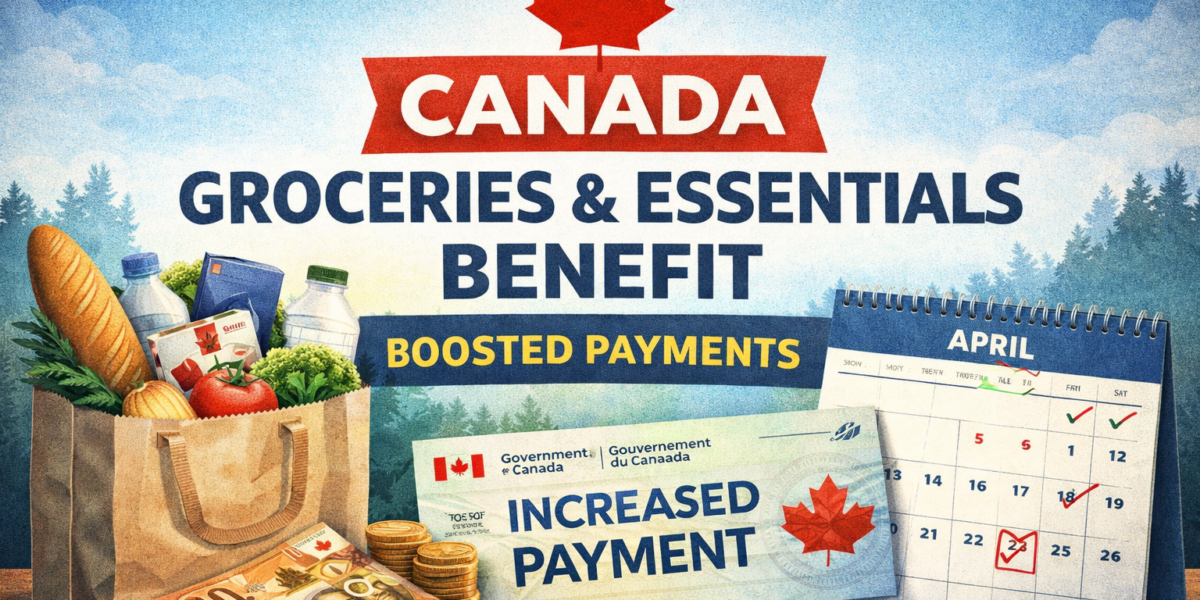
Canada Groceries & Essentials Benefit: Your Guide to the New, Boosted Payments
The GST Credit has been rebranded and significantly expanded. Here’s everything you need to know — who qualifies, when the money arrives, and how to make sure you don’t miss out.
This post is for general informational purposes only. Payment amounts and eligibility are determined by the CRA based on your tax return. Visit CRA My Account or canada.ca for official figures specific to your situation.
Canadians are feeling the squeeze at the grocery checkout line and on their monthly bills. In response, the federal government has officially upgraded one of its key support programs. The long-standing GST Credit has been rebranded and expanded — it is now called the Canada Groceries and Essentials Benefit.
While the name is new, it uses the same automatic delivery system as the old GST credit — just with significantly larger payouts designed to provide both immediate and long-term relief over the next five years.
What is the Canada Groceries & Essentials Benefit? It’s a tax-free quarterly payment designed to help low- and modest-income individuals and families offset the cost of living. Despite the name, you are not restricted to spending this money on food — you can use it for rent, transit, utility bills, medication, or anything else your household needs most. It is an income-tested benefit delivered automatically by the CRA.
How much can I get?
The amount you receive depends entirely on your adjusted family net income, your marital status, and how many children under 19 you have in your care. For the 2025–2026 benefit year (July 2025 to June 2026), the maximum annual base amounts are:
The 2026 upgrades: what’s new
Thanks to newly passed legislation (Bill C-19), the government is implementing two significant boosts to these payment amounts starting in 2026.
A lump-sum bonus equal to 50% of your total annual benefit amount, deposited as a separate one-time payment no later than June 2026. Designed to provide immediate relief right now.
Starting July 2026, your regular quarterly payments permanently increase by 25% across the board. This higher rate is guaranteed to stay in place for the next five years.
Total projected payouts for 2026
Because of the combination of the Spring Bonus and the 25% Boost, 2026 will see the largest payouts in the program’s history. Here are the maximum total amounts an eligible household could receive across 2026, combining the Spring Bonus and the boosted quarterly payments:
| Household situation | Maximum total — 2026 |
|---|---|
Single individual (no children) | $950 |
Couple with two children | $1,890 |
Single senior Net income of ~$25,000 | $950 |
The master schedule: when does the money arrive?
The regular benefit is paid quarterly. The Spring Bonus arrives as a separate, one-time payment. Here’s the full schedule for 2026:
| Estimated date | Payment type | Based on |
|---|---|---|
| April 2026 | Regular Quarterly | 2024 tax return |
| By June 2026 | 🌸 One-Time Spring Bonus | 2024 tax return |
| July 2026 | ☀️ First Boosted Payment | 2025 tax return |
| October 2026 | ☀️ Regular Boosted Payment | 2025 tax return |
The catch: why you have to file your taxes
This is the most important detail in this entire guide. No separate application is needed — the CRA calculates your eligibility and payment amount automatically. However, the CRA can only do this if you file your income tax returns. Failing to file means you will not receive a single dollar of this benefit, even if you are fully eligible.
Because different payments are based on different tax years, timing is crucial:
Common questions
No, but it is strongly recommended. Direct deposit is the fastest and most secure way to receive your payment. If the CRA has your banking information, the bonus will be deposited automatically. If they do not, you will receive a cheque in the mail, which will take longer to arrive.
Generally, no. Most federal benefits, including this one, cannot be seized to pay tax debts. However, they can sometimes be applied to other non-tax government debts, such as outstanding family support payments.
You must update the CRA immediately on any changes to your marital status, address, or number of children in your care. These changes directly affect how much money you receive, and delays in updating the CRA can result in missed or incorrect payments.
You can view your next expected payment amount, the date it will arrive, and your full statement of account at any time by signing in to CRA My Account at canada.ca.
The Canada Groceries and Essentials Benefit — whatever you call it — is real money that eligible Canadians are entitled to. The only thing standing between you and those payments is a filed tax return. If you haven’t filed yet, make that your priority this week.
Share this with a family member or friend who might be missing out on these payments.
Have questions? Drop them in the comments — we read every one.