Canada’s Registered Accounts Explained: TFSA vs. RRSP vs. FHSA
Plain-language guide to 2026 limits, withdrawals, and which account is right for you right now — no jargon, no fluff.
This post is for general educational purposes only and does not constitute financial or tax advice. Please consult a qualified financial advisor or CPA for advice specific to your situation.
If you’ve ever Googled “TFSA vs RRSP” and ended up more confused than when you started, you’re not alone. Canada’s registered accounts come with their own alphabet soup of rules, limits, and fine print — and the penalty for getting it wrong can be real money out of your pocket.
This guide breaks all three accounts down in plain language: what they are, how they work, how much you can put in, and — most importantly — which one is right for you right now.
What is a registered account? A savings or investment account registered with the Canada Revenue Agency (CRA) that gives you tax advantages — either your money grows tax-free, or you get a deduction today, or both. The three main registered accounts are the TFSA, the RRSP, and the FHSA (launched 2023). All three let you hold stocks, ETFs, mutual funds, GICs, and bonds inside them — not just cash. Think of them as tax-sheltered buckets you can fill with investments.
Your most flexible account
The TFSA launched in 2009 and quickly became the most popular registered account in Canada — and for good reason. Any growth inside a TFSA is completely tax-free, forever. Interest, dividends, capital gains — none of it is ever taxed, and you never have to report it on your tax return.
Who can open one
Any Canadian resident aged 18 or older with a valid SIN can open a TFSA. In Ontario, residents can open one at 18.
Contribution limits
Your room accumulates from every year you were 18+ and a Canadian resident. Always check your exact room on CRA My Account before contributing.
Withdrawals
Any amount, any time, for any reason — completely tax-free. The room comes back on January 1 of the following year. TFSA withdrawals never affect your income, your GST/HST credit, your Canada Child Benefit, or your OAS clawback.
Who should use a TFSA
- Lower or middle income earners — the tax-free growth matters more than an upfront deduction
- People saving for medium-term goals: emergency fund, car, travel, home renovation
- Retirees and seniors — withdrawals don’t trigger OAS clawback or affect GIS eligibility
- Anyone who wants maximum flexibility with no strings attached
The retirement powerhouse
The RRSP has been around since 1957 and is the original Canadian retirement account. The core idea: contribute now, get a tax deduction, pay tax later when you withdraw in retirement — when you’re hopefully in a lower tax bracket.
Who can open one
Any Canadian with earned income and a SIN can open an RRSP, up until the end of the year they turn 71. At 71, your RRSP must convert to a RRIF (Registered Retirement Income Fund) or be used to purchase an annuity.
Contribution limits
Earned income includes employment income, self-employment income, and rental income — but not investment income, pension income, or TFSA withdrawals. Unused room carries forward indefinitely.
Withdrawals
RRSP withdrawals are taxed as income in the year you take them, and withholding tax applies immediately (10% on the first $5,000, 20% up to $15,000, 30% above). Unlike a TFSA, withdrawn contribution room is lost permanently.
Who should use an RRSP
- Higher earners — the deduction is most valuable at high marginal rates
- Anyone earning over roughly $55,000/year in Ontario, where RRSP generally outperforms TFSA on a pure math basis
- Homebuyers using the Home Buyers’ Plan or students using the Lifelong Learning Plan
- Those who want to income-split with a lower-income spouse in retirement
The new kid — and a powerful one
Launched April 2023The First Home Savings Account launched April 1, 2023 and is genuinely the best thing to happen to Canadian homebuyers in years. It combines the best of both worlds: you get the RRSP-style deduction when you contribute, and withdrawals for a qualifying first home are completely tax-free — just like a TFSA. In other words, you get a tax break going in and pay no tax coming out.
Who can open one
You must be a Canadian resident, at least 18 years old, and a first-time home buyer — meaning you (and your spouse or common-law partner) have not owned a qualifying home that you lived in at any point during the current year or the preceding four calendar years.
Contribution limits
Withdrawals
Qualifying withdrawal (to buy your first home): completely tax-free — no tax on the growth, no tax on the principal. You must have a written agreement to buy or build before October 1 of the year after the withdrawal.
Non-qualifying withdrawal: fully taxable as income, similar to an RRSP withdrawal. Not ideal but still useful as a backup savings vehicle.
If you don’t buy a home: transfer the FHSA balance to your RRSP or RRIF tax-free at any time — it doesn’t eat into your RRSP room. The account must close by December 31 of the 15th year after opening (or the year you turn 71, whichever is earlier).
Who should use an FHSA
- Any first-time buyer under 71 — open one immediately if you even think you might buy a home in the next 15 years
- Renters saving toward homeownership — it’s the most tax-efficient vehicle available for a down payment
- High-income earners — the double tax advantage (deduction in + tax-free out) is worth real dollars at a 43%+ marginal rate
TFSA vs. RRSP vs. FHSA compared
| TFSA | RRSP | FHSA | |
|---|---|---|---|
| Tax deduction on contribution | No | Yes | Yes |
| Tax on growth | Tax-free | Tax-deferred | Tax-free |
| Tax on withdrawal | Never taxed | Taxed as income | Free (qualifying) |
| 2026 annual limit | $7,000 | 18% of income, max $33,810 | $8,000 |
| Lifetime limit | No cap | No cap | $40,000 |
| Unused room carries forward | Yes — indefinitely | Yes — indefinitely | One year only |
| Room restored on withdrawal | Yes (Jan 1 next year) | No — lost forever | No |
| Affects income-tested benefits | Never | Yes (on withdrawal) | No (qualifying) |
| Use for any goal | Yes — any purpose | Retirement primarily | First home only |
| Age limit | None | Must convert at 71 | Must close by 71 |
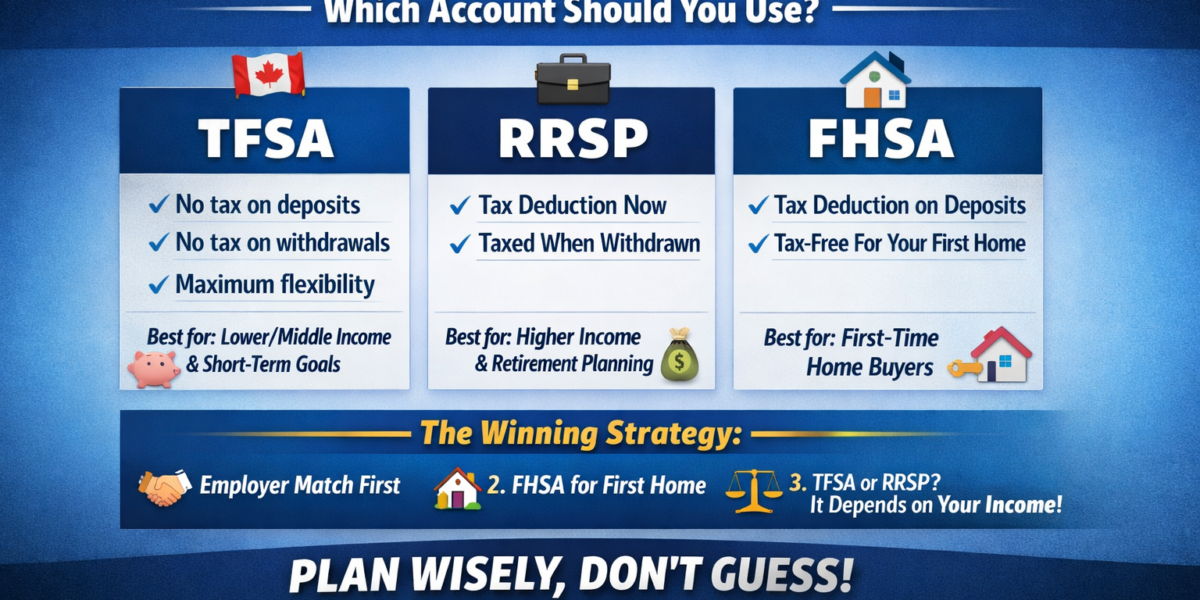
Which one first? A decision framework
Here’s a simple framework for prioritizing your contributions:
Prioritize in this order
Common mistakes to avoid
TFSA over-contribution
The 1% monthly penalty adds up fast. Always check CRA My Account before contributing — especially if you’ve made withdrawals in the same calendar year.
Early RRSP withdrawals
Withholding tax applies immediately and room is lost forever. Use your TFSA for emergencies instead, not your RRSP.
Leaving cash in registered accounts
Your TFSA, RRSP, and FHSA can hold ETFs and stocks. Leaving $40,000 in a 2% savings account when you could hold a diversified portfolio is a missed opportunity.
Waiting to open an FHSA
Room accumulates from the year you open it. Even if you can’t contribute the full $8,000, open it now and bank the room for next year.
Day-trading inside a TFSA
The CRA can audit and tax TFSA accounts deemed to be “carrying on a business.” Frequent options trading or day trading puts your tax-free status at risk.
2026 quick reference
Canada’s registered accounts are genuinely one of the best tools available for building long-term wealth — you just need to use them in the right order for your situation. The TFSA gives you flexibility, the RRSP rewards high earners, and the FHSA is the most powerful new account in a generation for first-time buyers.
And remember: these accounts are only as good as what you put inside them. Opening a registered account and leaving it in cash is like buying a high-performance car and never taking it out of the driveway.
Save this post for tax season and share it with a friend who’s been putting off opening a TFSA.
Have questions? Drop them in the comments — we read every one.