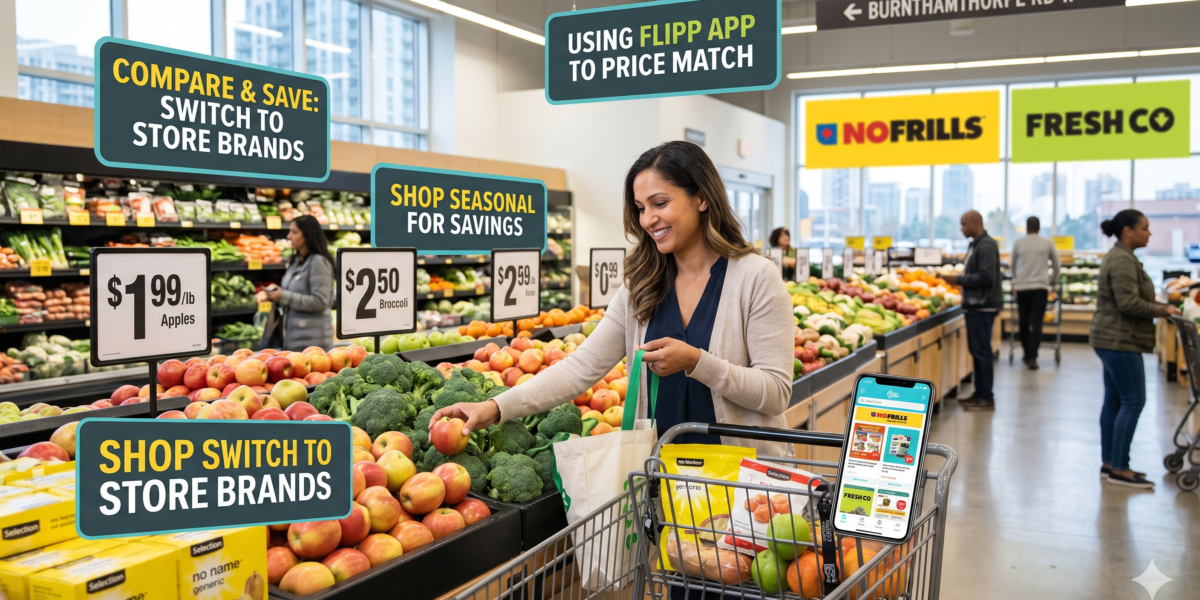
Grocery bills in Mississauga — and across Ontario — keep climbing. Canada’s Food Price Report 2026 projects a further 4–6% increase this year, with the average family of four expected to spend roughly $17,571 annually on food. If your grocery spending feels out of control, you are not alone, and you are not doing it wrong. Prices are genuinely higher. The good news: Mississauga residents have access to one of the most competitive grocery markets in Canada, with a wide range of discount stores, ethnic markets, and warehouse clubs that give budget-conscious shoppers real options. This guide gives you the numbers, the store-by-store breakdown, and a practical system for spending less without giving up the food your family enjoys.
Realistic Grocery Benchmarks for Mississauga
Before setting a grocery budget, you need a realistic baseline. The figures below are reasonable targets for Mississauga households in 2026. They are not minimums — they reflect what most households actually spend when shopping thoughtfully at mid-range and discount stores.
These ranges assume a mix of cooking at home, some store-brand purchases, and occasional name-brand items. Families eating mostly home-cooked meals and shopping at discount stores like No Frills or Food Basics can land at the lower end. Those who rely heavily on convenience foods, organic products, or premium retailers will be at the higher end — or above it.
Best Budget Grocery Stores in Mississauga
Mississauga has an excellent mix of grocery options spanning discount chains, ethnic supermarkets, and warehouse clubs. Knowing which stores to use for which purchases is more powerful than any coupon strategy.
Consistently ranked the cheapest grocery chain in Ontario. Accepts price matching and earns PC Optimum points. Multiple Mississauga locations including Burnhamthorpe Rd W and Queen St S.
A close competitor to No Frills and often cheaper on specific items like eggs and deli. Locations include Dixie Rd, Glen Erin Dr, and Hurontario St.
Discount banner from Sobeys. Offers price matching and strong produce quality relative to price. Well-regarded for a clean shopping experience at discount prices.
Best for pantry staples, proteins, dairy, and paper goods when bought in bulk. Unit prices are consistently lower, but requires a membership fee (~$65/year) to unlock savings.
Mississauga’s large multi-cultural supermarket near Heartland. Exceptional prices on fresh produce, international pantry items, and specialty cuts of meat.
Competitive on packaged goods and household essentials. Less consistent on produce pricing but worthwhile for combining grocery and non-food purchases in a single trip.
The Multi-Store Strategy
Savvy Mississauga shoppers rarely stick to one store. A common and effective approach is to anchor your weekly shop at No Frills or Food Basics, then supplement with Costco for bulk staples once or twice a month, and use ethnic markets like Nations Fresh Foods for produce and specialty ingredients. This approach can realistically save $80–$150 per month for a family of four compared to shopping exclusively at a full-service chain like Metro or Loblaws.
Building Your Weekly Grocery Budget
A grocery budget only works if it is grounded in how your household actually eats. Follow these steps to build one that you will actually stick to.
Step 1: Establish Your Monthly Ceiling
Start with your take-home pay and subtract fixed expenses: rent or mortgage, utilities, insurance, debt payments, and savings contributions. What remains is your discretionary spending pool. Groceries should account for roughly 10–15% of net household income for most Ontario households. If you are significantly above that, the tips in the next section can help you close the gap.
Step 2: Set a Weekly Target
Divide your monthly grocery ceiling by 4.3 (the average number of weeks in a month) to get a weekly target. Post this number on your fridge or set it as a spending cap in your banking app. A weekly target is more actionable than a monthly one because your grocery decisions happen week to week.
Step 3: Plan Meals Before You Shop
Meal planning is not about rigid schedules — it is about not buying food you will not eat. Before each shopping trip, decide on four to five dinners for the week. Write down only what you need to make those meals plus your regular staples. Studies consistently show that shopping with a list reduces spending by 15–25% compared to shopping without one.
Step 4: Track for One Month
Use your bank or credit card statements to track every grocery dollar for one full month. Most Canadian banks now categorize spending automatically. The goal is to spot where money leaks: impulse purchases, convenience items, pre-cut produce with a significant markup, and food that gets thrown out. You cannot fix what you have not measured.
10 Practical Ways to Spend Less on Groceries in Mississauga
- Use the Flipp app every week. Flipp aggregates all local flyers — No Frills, Food Basics, FreshCo, Walmart, Costco, and more — into one place. Browse it before building your shopping list and plan your meals around what is on sale.
- Choose store brands for staples. No Name (Loblaws/No Frills), Selection (Metro/Food Basics), and Compliments (Sobeys/FreshCo) cover nearly everything from canned goods to pasta to dairy. On most staples, switching to store brand saves 20–40% with no meaningful quality difference.
- Buy proteins in bulk and freeze. Chicken thighs, ground beef, pork shoulder, and whole salmon portions are substantially cheaper per kilogram when bought in large packs at Costco or on sale at discount chains. Portion and freeze on the same day.
- Eat seasonally and buy fresh produce at ethnic markets. Nations Fresh Foods in Mississauga often prices produce at a fraction of major chain prices. A bag of mangoes or a head of cauliflower that costs $4–5 at a chain can be $1.50–2.00 there. This is especially true for South Asian, East Asian, and Caribbean produce.
- Reduce food waste aggressively. The average Canadian household wastes $1,300 worth of food per year. In practice this means: use older produce first, store leafy greens properly (wrapped in paper towel in the crisper), and make one “use-it-up” meal each week from whatever is left in the fridge.
- Leverage the PC Optimum points program. If you shop at No Frills or Loblaws, PC Optimum points add up quickly. Load bonus offers on the app before shopping, and redeem for free groceries. A disciplined user can realistically earn $100–$200 in free groceries per year.
- Stop buying water. Single-use bottled water is one of the highest-cost-per-litre beverages you can buy. Mississauga tap water is safe and consistently rated among the best in Ontario. A basic pitcher filter or a reusable bottle eliminates this cost entirely.
- Cook dried beans and legumes instead of canned. A 1 kg bag of dried chickpeas costs about $3.50 and produces the equivalent of six cans. Lentils, black beans, and kidney beans work the same way. Batch cook on weekends and freeze in portions. This also works as a partial meat substitute for several meals per week.
- Match loyalty programs to your shopping pattern. PC Optimum for No Frills shoppers, Scene+ for Metro, and Air Miles for Food Basics. Pick one or two that match your regular stores and actually redeem your points — unclaimed loyalty points are money left on the table.
- Avoid shopping hungry or in a rush. Research consistently shows that shopping hungry leads to higher unplanned purchases. Shop after a meal, stick to your list, and if possible, shop without children on your most budget-sensitive week of the month.
Sample Monthly Grocery Budgets
The table below shows sample budgets by household type for Mississauga residents in 2026. These budgets assume primarily home cooking, a mix of store-brand and name-brand products, and shopping at a combination of No Frills or Food Basics plus one or two specialty stops per month.
| Household | Tight Budget | Moderate Budget | Comfortable Budget | Strategy |
|---|---|---|---|---|
| Single adult | $250–$300 | $350–$400 | $450–$550 | Mostly home cooking |
| Couple | $400–$480 | $550–$650 | $700–$850 | Mixed + 1 Costco run |
| Family of 3 | $600–$720 | $800–$950 | $1,000–$1,200 | Meal plan weekly |
| Family of 4 | $750–$900 | $1,100–$1,300 | $1,400–$1,600 | Meal plan + bulk buying |
| Family of 5+ | $950–$1,100 | $1,300–$1,550 | $1,600–$2,000 | Costco + discount chains |
What a Tight Budget Looks Like in Practice
A single adult targeting $275/month in Mississauga can realistically eat well on that budget. A typical week might look like: oats and eggs for most breakfasts, lentil soup or bean-based lunches, and dinners built around chicken thighs, rice, seasonal vegetables, and pasta with tomato sauce. Fresh fruit (bananas, apples, whatever is on sale) rounds things out. This is not a deprivation diet — it is a cooking-forward lifestyle that happens to be very affordable.
Frequently Asked Questions
What is the cheapest grocery store in Mississauga?
Based on shopper surveys and price comparisons across Ontario, No Frills and Food Basics consistently rank as the cheapest full-service grocery options in Mississauga. FreshCo is also competitive and often comparable on specific items. For the absolute lowest unit prices on many pantry staples, Costco wins — but only if you can use the quantities before they go to waste.
How much should a family of 4 spend on groceries in Mississauga per month?
A realistic target for a family of four in Mississauga shopping at discount stores and cooking primarily at home is $1,100–$1,300 per month in 2026. Families relying more on convenience foods, premium brands, or full-service chains will be higher. Canada’s Food Price Report 2026 puts the national average for a family of four at roughly $17,572 per year, or about $1,464/month — shopping smart can put you meaningfully below that.
Is it worth getting a Costco membership in Mississauga?
For a family of three or more, a Costco membership typically pays for itself within the first few months. The Mississauga Costco (Heartland area) is well-stocked. The membership is most valuable if you have freezer space for bulk proteins, can store large quantities of pantry staples, and buy regular household items there. For singles or couples with limited storage, the savings are less clear-cut and you should compare your specific purchases before committing.
Can I use Ontario Trillium Benefit or other programs to offset grocery costs?
Yes, indirectly. The Ontario Trillium Benefit (OTB) is a combined credit covering energy, sales tax, and property tax costs, and it frees up household cash that can go toward groceries. Additionally, the federal Groceries and Essentials Benefit (announced in 2024) provides direct payments to lower-income Canadians. If your household income qualifies, make sure you have filed your taxes with CRA and confirmed your eligibility for these programs.
Are ethnic grocery stores in Mississauga actually cheaper?
For produce, specialty proteins, and international pantry staples, yes — often significantly cheaper. Nations Fresh Foods is a prominent example in Mississauga, offering very competitive pricing on fresh produce, Asian sauces and noodles, South Asian spices, halal meats, and more. If your household cooking style incorporates any international cuisine, supplementing your main shop with ethnic supermarkets is one of the highest-ROI changes you can make to your grocery budget.
What apps help save money on groceries in Mississauga?
The most useful apps for Mississauga grocery shoppers are: Flipp (flyer aggregator with price-match search), PC Optimum (loyalty points for No Frills / Loblaws shoppers with weekly bonus offers), Checkout 51 (cashback on specific grocery items), and Flashfood (discounted near-expiry groceries from participating stores, sometimes 40–50% off).