RRSP Contribution Limit 2026: What You Need to Know
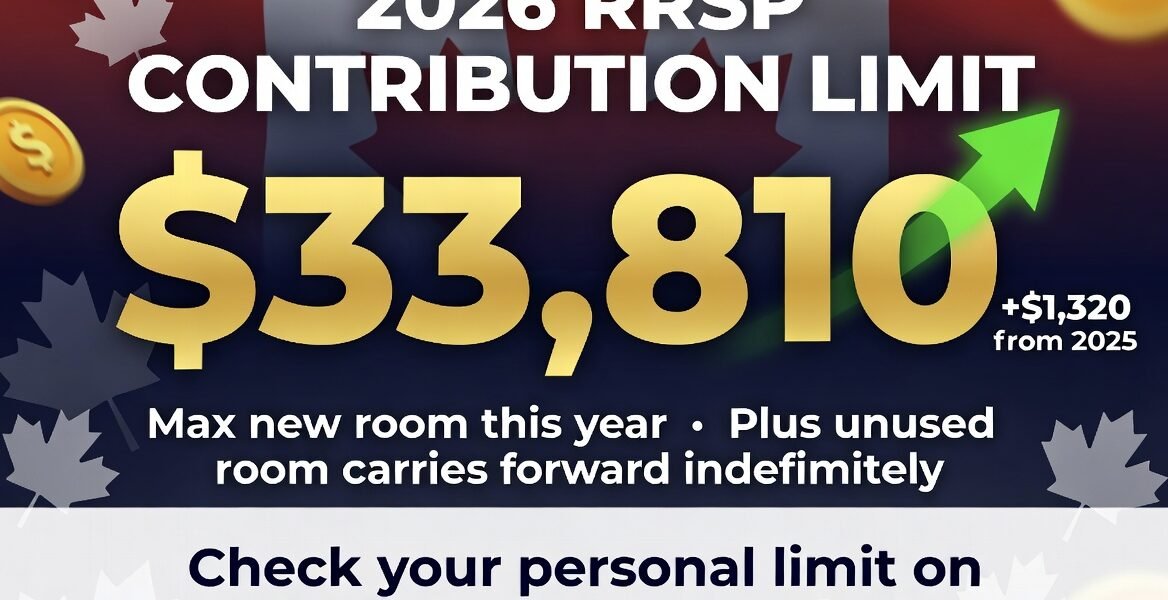
The 2026 RRSP dollar limit is $33,810 — but your personal limit depends on your income, pension plan, and unused room from past years. Here’s how to calculate it, when to contribute, and how to get the most out of your RRSP this year.
The 2026 RRSP dollar limit is $33,810 — up $1,320 from $32,490 in 2025. Your personal limit is 18% of your 2025 earned income, capped at $33,810, minus any pension adjustment, plus unused room carried forward.
- The deadline to contribute for the 2025 tax year was March 2, 2026
- The deadline for the 2026 tax year is March 1, 2027
- RRSP room carries forward indefinitely — there’s no expiry
- You must convert your RRSP by December 31 of the year you turn 71
What is the 2026 RRSP contribution limit?
The Canada Revenue Agency (CRA) sets an annual RRSP dollar limit — the maximum new contribution room any Canadian can earn in a given year. For 2026, that cap is $33,810, an increase of $1,320 from the 2025 limit of $32,490.
However, the dollar limit is a ceiling, not a flat entitlement. Your actual contribution room for 2026 depends on your personal earned income from 2025, any workplace pension plan adjustments, and unused room you’ve carried forward from prior years.
Most Canadians earn well below the income threshold needed to hit the dollar cap. If you earned $80,000 in 2025, your new RRSP room for 2026 is 18% × $80,000 = $14,400 — not $33,810. The cap only matters once your income crosses roughly $187,833.
How your personal RRSP room is calculated
The CRA calculates your RRSP deduction limit every year using a specific formula. Understanding it helps you plan contributions accurately — and avoid over-contributions.
Your exact limit is printed on your CRA Notice of Assessment (NOA) — the document CRA sends after processing your tax return. It’s also visible in real time on CRA My Account at canada.ca.
What counts as earned income for RRSP purposes?
Not all income creates RRSP room. The CRA uses a specific definition of “earned income” in its formula. Employment income, self-employment income (net), and rental income all count. Investment income (interest, dividends, capital gains) does not.
Sources that count as earned income include employment wages and salaries, self-employment business income (net of losses), net rental income, alimony and spousal support received, and research grants. Sources that do not count include interest, dividends, capital gains, RRSP or RRIF withdrawals, pension income, OAS, and CPP payments.
If you’re self-employed, your RRSP room is based on your net business income — after business expenses. A high-revenue year with significant expenses may create less room than expected. Business losses can also reduce earned income and therefore reduce RRSP room.
What is a Pension Adjustment (PA)?
If your employer contributes to a workplace pension plan on your behalf — a defined benefit (DB) or defined contribution (DC) pension — the CRA reduces your RRSP room by a Pension Adjustment. This prevents double-dipping on tax-sheltered retirement savings.
Your PA is reported in Box 52 of your T4 slip. Employees with generous defined-benefit pensions often have very little RRSP room as a result, while self-employed Canadians and those with no employer pension retain the full 18% room.
RRSP dollar limits: 2017 to 2026
| Year | Annual dollar limit | Change from prior year |
|---|---|---|
| 2017 | $26,010 | — |
| 2018 | $26,230 | +$220 |
| 2019 | $26,500 | +$270 |
| 2020 | $27,230 | +$730 |
| 2021 | $27,830 | +$600 |
| 2022 | $29,210 | +$1,380 |
| 2023 | $30,780 | +$1,570 |
| 2024 | $31,560 | +$780 |
| 2025 | $32,490 | +$930 |
| 2026 | $33,810 | +$1,320 |
The RRSP dollar limit is indexed to average Canadian wages — not CPI inflation — which is why it tends to climb more steadily than the TFSA limit. The 2027 RRSP limit has already been set by the CRA at $35,390, a further increase of $1,580.
Calculating your room: real-world examples
Amara, 34 — employed, no pension
Amara earned $75,000 in 2025. She has no employer pension plan and $8,000 of unused RRSP room carried forward from prior years.
+ $8,000 unused carry-forward
− $0 pension adjustment
= $21,500 total 2026 RRSP deduction limit
Derek, 48 — employed, defined-benefit pension
Derek earned $120,000 in 2025. His employer’s DB pension plan creates a Pension Adjustment of $18,000, reported on his T4. He has no unused carry-forward room.
+ $0 carry-forward
− $18,000 pension adjustment
= $3,600 total 2026 RRSP deduction limit
Derek’s generous pension nearly wipes out his RRSP room — a common outcome for public sector employees and those with generous DB plans.
Yuki, 29 — self-employed, never contributed
Yuki started freelancing in 2020 and has never contributed to an RRSP. Her average net self-employment income over the past five years has been $55,000, but she’s been too busy to set up her RRSP until now.
18% × $55,000 (2025 income) = $9,900 new room for 2026
+ ~$54,000 carry-forward
= ~$63,900 total 2026 RRSP deduction limit
Yuki has significant room built up — but her actual limit depends on her exact income each year. She should check her NOA or CRA My Account for the precise figure.
Marcus, 55 — high earner
Marcus earned $220,000 in 2025 — well above the income threshold needed to maximize RRSP room. He has a group RRSP at work but no DB pension.
+ carry-forward room (varies)
− $0 pension adjustment (group RRSP is not a pension plan)
= $33,810 new room + any unused carry-forward
Key RRSP deadlines for 2025 and 2026
The RRSP has an unusual rule: contributions made in the first 60 days of a new year can be applied to either the previous year’s return or the current year’s. This gives you flexibility to top up your RRSP after reviewing your full year income.
Last day to contribute and claim a deduction on your 2025 tax return. March 1, 2026 fell on a Sunday, so the deadline shifted to Monday, March 2.
Contribute anytime between now and March 1, 2027 to claim a deduction on your 2026 tax return. No rush — but earlier means more tax-free growth time.
Any contributions you make now (after March 2, 2026) still go into your RRSP and still grow tax-free — they just can’t be deducted on your 2025 return. They’ll be deducted when you file your 2026 return next spring. You can also choose to hold the deduction for a future year if you expect higher income then. Read more in our guide: the RRSP deadline just passed — here’s what to do next.
When to contribute — lump sum vs. monthly
Contributing a lump sum on January 1 maximizes the amount of time your money grows tax-sheltered inside the RRSP. But for most Canadians, a monthly automatic contribution is more practical — and eliminates the discipline required to come up with a large sum at year-end.
Contributing $2,817.50/month through 2026 would reach the full $33,810 cap by December 31. If that’s more than your personal limit allows, divide your personal deduction limit by 12 to get your monthly target.
Spousal RRSPs: income splitting for couples
A spousal RRSP is one of the most effective legal income-splitting tools available to Canadian couples. Here’s how it works: the higher-income spouse contributes to an RRSP in their partner’s name. The contributor claims the deduction (reducing their own taxable income today), while the account belongs to the spouse — who pays tax on withdrawals in retirement, typically at a lower rate.
Done well, this can save a couple tens of thousands of dollars in lifetime taxes by equalizing income in retirement and keeping both partners below higher tax brackets.
If the spouse who owns the spousal RRSP withdraws funds within three calendar years of the last contribution, the CRA attributes that withdrawal back to the contributing spouse — meaning the contributor pays the tax, not the recipient. For example: if you contributed to a spousal RRSP in 2024, any withdrawals before the end of 2027 will trigger attribution. Plan contributions and withdrawals at least three full calendar years apart.
Spousal RRSP rules at a glance
- The contributor claims the deduction — it uses their RRSP room
- The annuitant (recipient spouse) owns the account and pays tax on withdrawals
- You can contribute to a spousal RRSP even after you turn 71, as long as your spouse is under 71 and you still have contribution room
- Contributions to a spousal RRSP count against your own RRSP deduction limit — not your spouse’s
- There are no spousal TFSAs — the spousal RRSP is the only registered account with this structure
RRSP over-contributions: the $2,000 buffer
Unlike the TFSA — which has no grace period — the CRA allows a $2,000 lifetime over-contribution buffer for RRSPs. This means you can technically hold up to $2,000 over your deduction limit without triggering a penalty. However, this buffer is not a tax deduction — you cannot claim the excess as a deduction until you have room to absorb it.
If you exceed your deduction limit by more than $2,000, the CRA charges a 1% per month penalty tax on the excess amount. To correct it, withdraw the excess and file Form T1-OVP (Individual Tax Return for RRSP, PRPP and SPP Excess Contributions) within 90 days of the end of the year in which the over-contribution occurred.
The buffer exists for accidental over-contributions — timing errors, confusion about carryforward room, or administrative delays. It’s not a strategy. Intentionally using it means holding non-deductible funds in your RRSP, which only becomes useful once new room opens up in future years.
How to find your personal RRSP deduction limit
- Check your Notice of Assessment (NOA). After you file your tax return each year, CRA mails (or posts to My Account) your NOA. Look for the line “RRSP deduction limit for [year].” This is the most reliable source.
- Log in to CRA My Account. Go to canada.ca, sign in to My Account, and navigate to “RRSP and savings plans.” Your current deduction limit is displayed — though it may not reflect very recent contributions your institution hasn’t yet reported.
- Use the RRSP calculator on this site. Enter your prior year income, any pension adjustment (from Box 52 on your T4), and your carry-forward room from your last NOA to get an estimate.
- Call CRA TIPS. The Tax Information Phone Service at 1-800-267-6999 can read your contribution room over the phone after identity verification.
CRA My Account shows your deduction limit as of the start of the year, based on information your financial institutions have reported. Contributions you make during the current year are not subtracted automatically. Always track your own contributions alongside what CRA shows to avoid accidental over-contributions.
What happens to your RRSP when you turn 71?
You must close your RRSP by December 31 of the year you turn 71. At that point, you have three options: convert it to a Registered Retirement Income Fund (RRIF), purchase a life or fixed-term annuity, or withdraw the entire balance as cash.
Most Canadians convert to a RRIF, which requires minimum annual withdrawals starting the following year. Those withdrawals are taxed as income — which is the design intent of the RRSP: you defer tax during your earning years, then pay it in retirement at (ideally) a lower marginal rate. Tracking your overall retirement assets with a net worth tracker can help you plan the right conversion timing.
One often-overlooked strategy: if you turn 71 in 2026 and still have earned income, consider making one final lump-sum RRSP contribution before December 31 to use up any remaining room and claim a last deduction. You cannot contribute to your own RRSP after the conversion deadline — but you can still contribute to a spousal RRSP as long as your spouse is 71 or younger and you still have contribution room.
RRSP vs. TFSA: which should you prioritize in 2026?
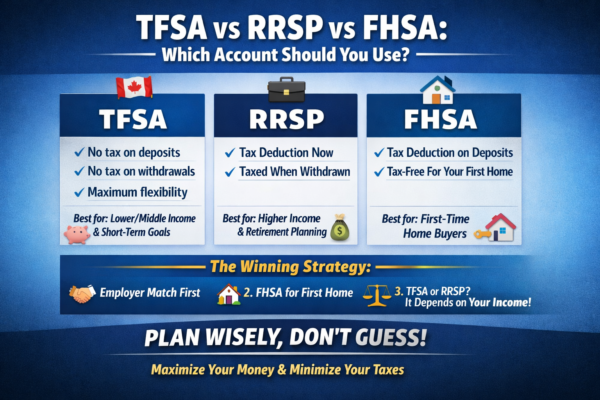
The two accounts aren’t mutually exclusive — most Canadians benefit from using both. But the order matters, and it depends heavily on your current income and where you expect to land in retirement. For a full comparison of all three registered accounts, see our guide to TFSA vs. RRSP vs. FHSA.
Prioritize the RRSP if: your current marginal tax rate is high (30%+) and you expect a lower income in retirement. The deduction today is worth more than the tax you’ll owe on withdrawals later. This typically means Canadians earning $80,000 or more benefit most from RRSP contributions.
Prioritize the TFSA if: your income is lower (under ~$50,000), you’re in a low tax bracket and don’t expect significant retirement income, or you want flexibility — TFSA withdrawals have no tax consequence and don’t affect income-tested benefits like OAS or GIS. See our TFSA contribution room guide to check how much room you have available this year.
Use both strategically: contribute to the RRSP in high-income years to reduce your taxable income, then reinvest the refund into your TFSA. In lower-income years (parental leave, career transitions), TFSA contributions may be the better move.
If your income is above $80,000 and you have RRSP room, contribute to your RRSP first this year — the tax deduction is most powerful at higher marginal rates. Under $50,000? The TFSA is likely the better default. Between $50,000–$80,000? It depends on your retirement income expectations and whether you’ll receive CPP, OAS, or a workplace pension.
Frequently asked questions
Disclaimer: This article is for educational purposes only and does not constitute personalized financial or tax advice. RRSP rules are complex and individual situations vary. Always verify your deduction limit on your Notice of Assessment or through CRA My Account, and consult a qualified tax professional for advice specific to your situation.