
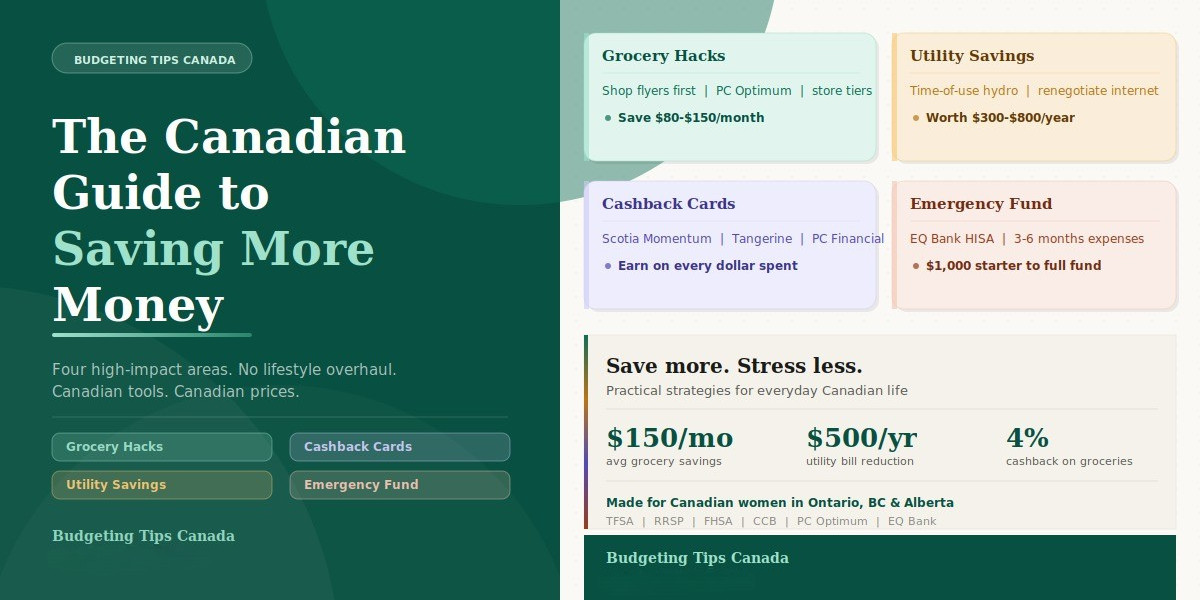
The Canadian Guide to Saving More Money
Four high-impact areas where most households have real money to save — without overhauling your lifestyle. Canadian tools, Canadian prices, Canadian context.
Flip the script: instead of planning your meals and then buying ingredients, check the weekly flyers first, then build your meals around what’s on sale. Use the Flipp app — it aggregates all major Canadian grocery chains in one place. Protein and produce sales alone can save $5–$15 per shop.
| Tier | Stores | Best use |
|---|---|---|
| Premium | Loblaws, Sobeys, Metro | Full selection; higher base prices |
| Mid-tier | Food Basics, FreshCo, No Frills | Where budget-savvy shoppers do most of their weekly shop |
| Discount | Walmart Grocery, Costco, T&T | Bulk staples, produce deals |
Most Ontarians can save $80–$150/month by shifting 60–70% of their shop to No Frills or FreshCo vs. full-price Loblaws.
Don’t just collect points passively — watch for “Spend $X, earn X points” bonus offers and time your larger shops around them. Stack with a PC Financial Mastercard and your points accumulate significantly faster. Redeem when you hit at least 20,000 points ($20 value).
Ontario Hydro customers on Time-of-Use (TOU) pricing pay different rates depending on when they use electricity. Shift laundry, the dishwasher, and your oven to evenings and weekends — the off-peak window — and you can cut your hydro bill by 10–20% with zero lifestyle change.
Most Canadians pay full retail rate because they signed up once and never called back. Every 12–18 months, call your provider and ask for a retention deal — mention a competitor’s current promo. In most Ontario markets you should be able to get 500 Mbps–1 Gbps for $55–$70/month if you push back.
Canada has some of the highest mobile plan costs in the world, but competition has improved. Target $35–$45/month for 15–25 GB on Freedom Mobile, Public Mobile, or Koodo. If you’re paying $65+ for a plan you barely use, that’s $240–$360/year in unnecessary spending. Watch for Black Friday and Boxing Day promos — that’s when the best deals drop.
Dropping your home temperature by just 2°C at night and while you’re out can reduce your gas bill by 5–10%. A smart thermostat (like an Ecobee, which is Canadian-made) pays for itself in under two years. Check Enbridge Gas rebates — they periodically offer $100+ on qualifying thermostats.
This one habit is worth $300–$800/year for most households.
Many Canadians use one card for high-cashback categories (groceries, gas) and a flat-rate card for everything else. This maximizes return without adding complexity.
The standard guidance is 3–6 months of essential expenses — rent or mortgage, groceries, utilities, transportation, minimum debt payments, and childcare if applicable. Not your full spending, just what you need to stay housed and solvent.
Your emergency fund should be liquid (accessible within 1–2 business days), separate from your chequing account, and earning something. High-interest savings accounts (HISAs) currently offer 4.0%–5.0% in Canada.
Set up an automatic transfer on every payday — even $50 or $100 — into your emergency fund account. Treat it like a bill. People who automate it almost always build it. People who try to “save what’s left over” rarely do.
Redirect that same automatic transfer toward your next goal. For most Canadian women in the 25–44 range: TFSA investing first, then FHSA (if you’re a first-time buyer), then RRSP. The emergency fund doesn’t grow forever — it has a target. Hit it, then redeploy the savings power.
Putting it all together
These four areas are interconnected. Cut $150/month from groceries and $80/month from utilities, put that spending on a cashback card to earn while you spend, and auto-transfer $200/month to your emergency fund — and you’ve built $2,400 in savings in a year while also collecting rewards on everyday expenses.
None of this requires a dramatic lifestyle change. It requires knowing where the leaks are — and plugging them one at a time.
