FHSA Canada 2026: The Complete Guide for First-Time Buyers
The First Home Savings Account is the most powerful savings tool ever created for Canadian first-time buyers — tax deductions going in, tax-free growth, and no tax on withdrawal. As inflation continues to pressure Canadian budgets, here is everything you need to know to use it effectively in 2026.
The FHSA lets eligible first-time buyers contribute up to $8,000/year and $40,000 lifetime, claim a tax deduction on contributions, and withdraw tax-free to buy a qualifying home — with no repayment required.
- Annual limit: $8,000 | Lifetime limit: $40,000 | Max carryforward: $8,000/year
- Contributions are tax-deductible (like an RRSP); qualifying withdrawals are tax-free (like a TFSA)
- No repayment required on qualifying withdrawals — unlike the RRSP Home Buyers’ Plan
- If you never buy a home, transfer the balance tax-free to your RRSP or RRIF
- You must open an FHSA before contribution room starts accumulating — don’t wait
What is the FHSA?
The First Home Savings Account (FHSA) is a registered savings account introduced by the federal government in 2023 to help Canadians save for their first home. It combines the best features of an RRSP and a TFSA in a structure that has never existed before:
- Like an RRSP: contributions are tax-deductible, reducing your taxable income in the year you claim them
- Like a TFSA: qualifying withdrawals for a home purchase are completely tax-free — including all investment growth
- Unlike either: no repayment required on qualifying withdrawals (unlike the RRSP Home Buyers’ Plan)
That double tax advantage — deductible in, tax-free out — is genuinely unique in the Canadian tax system. No other account offers it. For first-time buyers in a high-cost housing market, it’s one of the most useful first-time home buyer incentives the federal government has ever created.
Who is eligible for an FHSA?
To open an FHSA, you must meet all three of the following criteria at the time you open the account:
- Be a Canadian resident for tax purposes at the time of opening.
- Be at least 18 years old (and no older than 71 by December 31 of the year you open the account).
- Be a first-time home buyer — meaning neither you nor your spouse or common-law partner has owned a qualifying home that you lived in as your principal residence at any point during the current calendar year before opening, or during the four preceding calendar years.
The first-time buyer definition uses a rolling 4-year lookback. If you owned a home but stopped living in it as your principal residence more than 4 years ago, you may be eligible again. Owning a rental property you never lived in does not disqualify you. And if you immigrated to Canada and owned a home abroad, that foreign home counts toward the lookback — even if you never owned Canadian property.
My spouse owns a home — can I still open an FHSA?
Possibly. For the purpose of opening an FHSA, the eligibility rules consider whether you or your spouse owned a home you lived in as a principal residence. If your spouse currently owns the home you both live in, you do not qualify to open an FHSA. However, if you live in a home owned solely by your spouse (and you have never personally owned one), your eligibility depends on whether you resided in a home your spouse owned as your principal residence in the current or preceding 4 years — if yes, you’re not eligible to open an account.
This rule is different from the qualifying withdrawal rules, which only look at your own ownership history, not your spouse’s. See the withdrawals section for details.
Contribution rules: limits, carryforward, and deadlines
Annual and lifetime limits
You can contribute up to $8,000 per calendar year, subject to a $40,000 lifetime limit. At maximum contribution pace, you can fill your FHSA completely in five years. The annual limit has not changed since the FHSA launched in 2023, and the CRA confirmed it remains at $8,000 for 2026.
The carryforward rule — and why it’s critical to open early
Unlike the TFSA, FHSA contribution room does not accumulate automatically from the time you turn 18. Room only begins to build once you actually open an FHSA for the first time. This is the most important practical implication of the FHSA rules: opening the account starts the clock, even if you contribute nothing that year.
Once you have opened an FHSA, unused annual room carries forward — but only up to a maximum carryforward of $8,000. You cannot accumulate more than one year of unused room. The maximum you can contribute in any single year is therefore $16,000 (the current year’s $8,000 plus up to $8,000 carried from the prior year).
Waiting to open your FHSA until you’re ready to buy costs you contribution room permanently. If you’re eligible today but open your account two years from now, you’ve forfeited up to $16,000 in room that can never be recovered. Opening the account takes 15 minutes and costs nothing. The room accumulates whether you contribute or not — but only after you open it.
Contribution deadline: December 31, no exceptions
Unlike the RRSP — which has a 60-day grace period that lets contributions made in January and February apply to the previous tax year — the FHSA contribution deadline is December 31 of the relevant tax year. A contribution made on January 1, 2026 cannot be deducted on your 2025 tax return.
If your income is low this year and you expect it to rise significantly, consider contributing to your FHSA now but holding your deduction for a future year when the tax savings will be larger. Check our guide on Canadian tax rates and brackets to see how much a deduction in a higher bracket could save you compared to today.
What about RRSP transfers?
You can transfer funds from an existing RRSP to your FHSA. These transfers count against your FHSA annual and lifetime limits. Critically, RRSP-to-FHSA transfers are not tax-deductible — because the funds were already deducted when you contributed to the RRSP. The transfer doesn’t generate a second deduction, and it does not restore your RRSP contribution room.
What can you hold in an FHSA?
An FHSA can hold the same eligible investments as an RRSP or TFSA. This includes:
- High-Interest Savings Accounts (HISA)
- Guaranteed Investment Certificates (GICs)
- ETFs (exchange-traded funds), Mutual funds, and Stocks
You can have multiple FHSAs at different financial institutions — for example, a high-interest savings FHSA at one bank and an investment FHSA at a brokerage. Your combined contributions across all accounts cannot exceed your personal FHSA limits.
Making a qualifying withdrawal
When you’re ready to buy, you can withdraw all funds from your FHSA completely tax-free — including all investment growth — as long as you meet the following conditions at the time of withdrawal:
- You must be a first-time home buyer for withdrawal purposes
- You must have a written purchase agreement to buy or build a qualifying home
- You must not have acquired the home more than 30 days before making the withdrawal
- You must be a Canadian resident from withdrawal until acquisition
- You must occupy or intend to occupy the home as your principal place of residence
- You must complete Form RC725 (Request to Make a Qualifying Withdrawal)
For making a qualifying withdrawal, “first-time home buyer” is defined differently than for opening the account. When withdrawing, only your own ownership history matters — your spouse’s ownership of a home you live in does not disqualify you. This means someone who lives in a home owned solely by their partner could make a qualifying FHSA withdrawal toward a home purchase.
What if you never buy a home?
The FHSA has a built-in no-loss guarantee: if you decide not to buy a home, you can transfer your entire FHSA balance to your RRSP or RRIF — completely tax-free, and without using any RRSP contribution room.
The account must be closed by the earlier of:
- December 31 of the year of the 15th anniversary of opening
- December 31 of the year you turn 71
- December 31 of the year after your first qualifying withdrawal
Even if you end up never buying a home, you still benefited from years of tax-deductible contributions, tax-free growth, and a tax-free RRSP transfer at the end. The only scenario where the FHSA doesn’t help is if you don’t open one.
The ultimate power move: FHSA + RRSP Home Buyers’ Plan
You can use both the FHSA and the RRSP Home Buyers’ Plan (HBP) for the same home purchase. This is one of the most powerful financial strategies available to Canadian first-time buyers. For a deeper dive into the HBP mechanics, see our guide on how to use the RRSP HBP effectively in 2026.
Maximum tax-sheltered down payment per person in 2026
Per-person maximum: $100,000 in tax-sheltered down payment funds. For a couple where both partners are eligible: up to $200,000 combined.
The key difference: FHSA withdrawals never need to be repaid. HBP withdrawals must be repaid over 15 years. This makes the FHSA the more powerful tool — but using both maximizes your total accessible down payment.
See our registered accounts comparison guide for a deeper look at how these three accounts work together.
Real-world FHSA contribution room scenarios
Priya, 26 — opened FHSA in 2023, contributed $5,000 each year
Priya opened her FHSA in January 2023 when it launched and has contributed $5,000 per year since.
2024: room = $8,000 + $3,000 = $11,000 → contributed $5,000 → $6,000 unused
2025: room = $8,000 + $6,000 (but carryforward capped at $8,000) = $16,000 → contributed $5,000 → $11,000 unused
2026: room = $8,000 + $8,000 (cap) = $16,000 available
Total contributed to date: $15,000 — lifetime room remaining: $25,000
Marcus, 29 — opened FHSA in 2025 but made no contributions
Marcus was eligible in 2023 but didn’t open his FHSA until December 2025. He contributed nothing in 2025.
2026: room = $8,000 (new) + $8,000 (carryforward) = $16,000 available
Lost opportunity: $16,000 of room he could have had if he opened in 2023 is permanently gone
FHSA vs. TFSA vs. RRSP: how they compare
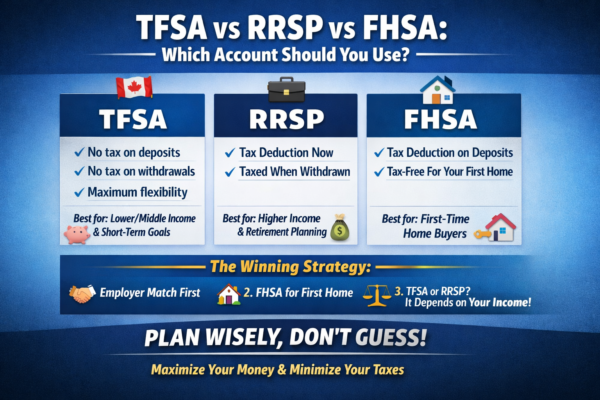
| Feature | FHSA | RRSP | TFSA |
|---|---|---|---|
| Contributions tax-deductible? | Yes | Yes | No |
| Withdrawals tax-free? | Qualifying only | No — taxable as income | Yes — always |
| Investment growth taxed? | Never | Not until withdrawal | Never |
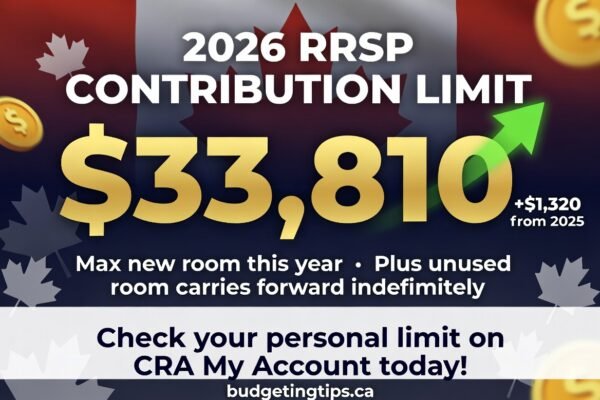
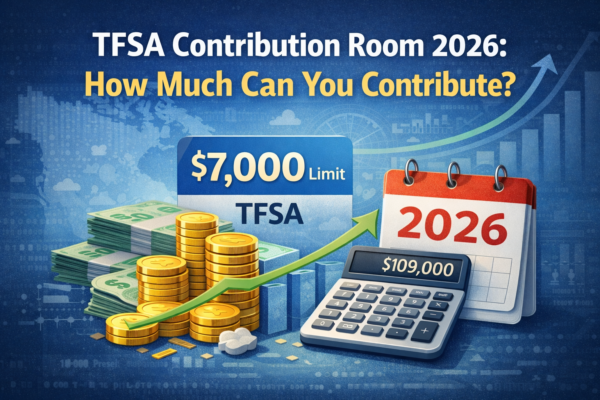
| Annual limit (2026) | $8,000 | $33,810 (or 18% of income) | $7,000 |
| Room accumulates automatically? | No — must open account first | Based on earned income | Yes — from age 18 |
For most first-time buyers, the priority order should be: FHSA first (best tax treatment for home savings), then RRSP if in a high tax bracket, then TFSA for remaining savings. See our full registered accounts guide for a detailed breakdown.
How to open an FHSA
- Confirm your eligibility. Verify you meet the age, residency, and first-time buyer criteria.
- Choose an institution. Consider a high-interest savings FHSA or an investment FHSA. You can have both.
- Open the account. Most banks allow online applications. You’ll need your SIN and government ID.
- File Schedule 15 with your tax return. In the year you open your first FHSA, you must complete Schedule 15 when filing — even with no contributions. For more tips on filing, see our Canadian tax filing checklist.
- Contribute and track your room.
Frequently asked questions
Disclaimer: This article is for educational purposes only and does not constitute personalized financial, tax, or legal advice. Always verify eligibility with CRA My Account and consult a qualified tax professional.