The CCB–RRSP Connection:
The Strategy Most Canadian Parents Miss
Your RRSP contribution doesn’t just cut your tax bill — it can quietly unlock thousands of dollars more in Canada Child Benefit every year. Here’s how.
Most Canadians know that contributing to an RRSP reduces taxable income. Fewer realize that lower net income also increases their Canada Child Benefit — sometimes dramatically. For families with young children, the RRSP–CCB connection is one of the most powerful and underused tax-planning tools available for Canadian families.
The Canada Child Benefit is income-tested. That means every dollar you reduce your adjusted family net income (AFNI) has the potential to flow back to your family — not just as tax savings at filing time, but as higher monthly CCB payments for the entire following year. When you combine these two effects, the real return on an RRSP contribution for parents can far exceed what most Canadians expect.
How the Canada Child Benefit Actually Works
The CCB is a tax-free monthly payment from the CRA to eligible families with children under 18. For the 2024–25 benefit year, the maximum annual amounts are:
| Child’s Age | Maximum Annual CCB | Maximum Monthly |
|---|---|---|
| Under 6 years | $7,787 per child | $648.91 |
| 6 to 17 years | $6,570 per child | $547.50 |
Here’s the key: the CRA calculates your CCB entitlement based on your adjusted family net income (AFNI) from the prior tax year. For example, CCB payments from July 2025 to June 2026 are based on your 2024 tax return. This timing matters enormously for planning.
AFNI = Net income (line 23600) of you and your spouse/common-law partner, combined. RRSP contributions reduce your net income, which directly reduces your AFNI. Lower AFNI = higher CCB.
The CCB Reduction Rate: Why Every Dollar Counts
The CCB begins to phase out once family net income exceeds $36,502 (2024 threshold). The reduction rate depends on your income level and the number of children you have:
| AFNI Range | Reduction Rate (1 child) | Reduction Rate (2 children) | Reduction Rate (3+ children) |
|---|---|---|---|
| $36,502 – $68,708 | 13.5% | 19.0% | 22.0% |
| Over $68,708 | 5.7% | 9.5% | 13.5% |
What this means in practice: if your family AFNI is between roughly $36,500 and $68,700, each $1,000 reduction in net income restores $135 to $220 per year in CCB, depending on how many children you have — on top of any income tax savings from the deduction itself.
The Hidden Multiplier Effect of RRSP Contributions
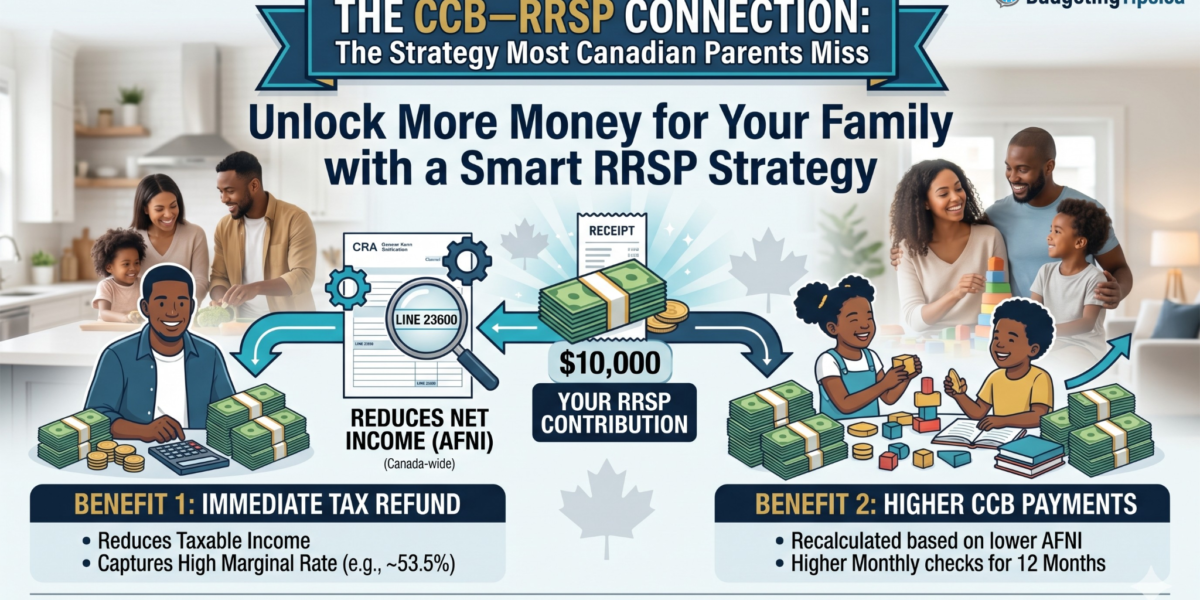
This is where the “hidden connection” becomes concrete. When a parent contributes to an RRSP, the contribution deducts from their net income. That triggers two distinct financial benefits simultaneously:
Benefit 1 — Tax refund at filing: The contribution reduces taxable income, generating a refund based on the marginal tax rate. In Ontario, marginal rates range from roughly 20% to 53.5% depending on income.
Benefit 2 — CCB boost for 12 months: The lower net income is reported on the tax return, which CRA uses to recalculate CCB. Higher CCB payments flow monthly for an entire benefit year.
Together, the combined return — tax refund plus CCB recovery — can make an RRSP contribution exceptionally efficient for eligible families.
Family of four in Ontario — combined AFNI $80,000
The lower-income spouse earns $45,000. They contribute $5,000 to their RRSP, reducing their net income to $40,000. Combined AFNI drops from $80,000 to $75,000.
Tax refund (Ontario, ~29.65% marginal rate): approximately $1,482
CCB impact (2 children, AFNI reduced by $5,000 in lower bracket): 9.5% × $5,000 = $475 more per year in CCB payments
💡 Total first-year benefit: ~$1,957 — on a $5,000 RRSP contribution. That’s an immediate return of nearly 39%, before any investment growth inside the RRSP.
Which Spouse Should Make the RRSP Contribution?
This is one of the most overlooked optimization questions in family tax planning. The answer isn’t always “the higher earner.”
When the higher earner contributes:
You capture the largest tax refund because more income is sheltered at a higher marginal rate. If family AFNI is already well above $68,708, this is often the priority.
When the lower earner contributes:
If the lower-earning spouse’s income sits in the phase-out corridor between $36,502 and $68,708, their contribution reduces AFNI in the band with the steepest CCB reduction rates — recovering the most benefit per dollar. The tax refund may be smaller, but the combined CCB recovery can more than compensate.
A higher earner can contribute to a spousal RRSP in the lower-income partner’s name. The contributor gets the deduction (and the tax refund at their higher marginal rate), while the funds grow in the spouse’s plan — potentially to be withdrawn at a lower tax rate in retirement. Used strategically, a spousal RRSP can also help shift future income and further reduce AFNI in retirement years when pension splitting rules don’t apply.
The Timing Dimension: RRSP Deadline vs. CCB Benefit Year
Understanding the timing is critical to maximizing this strategy. The CCB benefit year runs from July to June, and is based on the prior calendar year’s tax return. The RRSP contribution deadline is 60 days after December 31 (i.e., the first 60 days of the following year count toward the prior tax year’s deduction).
| RRSP Contribution Made | Deducted on Tax Return | CCB Adjusted From |
|---|---|---|
| Any time in 2024, or by Feb 28 2025 | 2024 return (filed spring 2025) | July 2025 |
| Any time in 2025, or by Mar 1 2026 | 2025 return (filed spring 2026) | July 2026 |
| Any time in 2026, or by Mar 1 2027 | 2026 return (filed spring 2027) | July 2027 |
This means your RRSP contribution made before the March 2026 deadline will reduce your 2025 net income, which triggers higher CCB payments from July 2026 onward — the effect persists for 12 full months. File early to start receiving the adjusted payments sooner.
How Much Extra CCB Can Families Actually Recover?
The numbers become more compelling the more children a family has, and the closer AFNI sits to the phase-out range. Here’s an illustration of potential annual CCB recovery from a $10,000 combined RRSP contribution:
| Family AFNI Before Contribution | 1 Child | 2 Children | 3 Children |
|---|---|---|---|
| $45,000 (lower bracket) | $1,350/yr | $1,900/yr | $2,200/yr |
| $75,000 (upper bracket) | $570/yr | $950/yr | $1,350/yr |
| Straddles $68,708 threshold | Mixed rate applies — potential to shift all $10K into lower bracket with higher recovery | ||
These figures represent CCB recovery alone, before adding the income tax refund. For families near the phase-out thresholds with two or more children, the combined effective return on RRSP contributions can be remarkable.
The Core Insight
An RRSP contribution for a parent isn’t just a retirement move — it’s simultaneously a tax refund trigger, a CCB booster, and a wealth-building action. For families with children in the phase-out range, the combined annual return on capital contributed can easily exceed 40–50% before investment growth. No other registered account delivers this triple effect.
The Strategy in Practice: A Step-by-Step Approach
- 1Know your RRSP contribution room
Check your current room on your Notice of Assessment or through My Account on the CRA website. Unused room carries forward indefinitely, so you can make a larger contribution in a high-income year. See our full guide to RRSP contribution room for 2026.
- 2Estimate your current family AFNI
Add your net income (line 23600) and your spouse’s net income. Compare this to the CCB phase-out thresholds. Identify how much income reduction would produce the highest combined benefit.
- 3Model both spouses’ contributions
Use the CRA’s Child and Family Benefits Calculator to estimate how different AFNI levels affect your CCB. Run the numbers for the higher earner contributing versus the lower earner, and for spousal RRSP options.
- 4Contribute strategically before the deadline
The first 60 days of the calendar year count toward the prior year’s contribution. A contribution made in January or February 2026 still reduces 2025 net income. Don’t miss this window. Missed the 2025 deadline? Here’s what to do next.
- 5File your return early
The CRA recalculates CCB when it processes your return. Filing in February or early March rather than April means your higher CCB payments begin in July without any delay.
- 6Reinvest the CCB boost
Consider directing recovered CCB payments into your child’s RESP. CCB is tax-free income — there’s no better source to fund the Canada Education Savings Grant (CESG), which adds a 20% federal match on contributions up to $2,500 per year.
Common Mistakes That Cost Families Thousands
For a deeper dive, see our full article on 7 common RRSP mistakes Canadians make. The most relevant ones for CCB-eligible parents are below.
1. Only the higher earner contributes, always
Reflexively maximizing the higher earner’s RRSP ignores the CCB phase-out mechanics. In many cases, a contribution by the lower-income spouse — especially one whose income sits between $36,500 and $68,700 — recovers more total value once CCB is included.
2. Waiting too long to file
Filing in April instead of February means you may not see the CCB adjustment until October rather than July — a gap of three to four months of lower CCB payments. For families recovering hundreds of dollars per month, this delay is meaningful.
3. Ignoring spousal RRSP as an income-splitting tool
Many parents focus exclusively on individual RRSP accounts and overlook the spousal RRSP. The spousal contribution captures the deduction for the contributor while building assets in the lower-income partner’s name — doubly effective when that partner is also in the CCB phase-out corridor.
4. Not recalculating when a new child arrives
Each additional child amplifies the CCB recovery rate. A family that ran the numbers for one child should revisit their RRSP strategy after having a second or third. The optimal contribution amount and the ideal contributing spouse may both change.
5. Treating CCB as unrelated to tax planning
Many Canadians mentally separate their registered account strategy from their benefits. The CRA doesn’t — everything flows from the same net income calculation. A comprehensive approach treats RRSP contributions, TFSA room, CCB, CCTB, GST/HST credit, and even OAS/GIS in retirement as interconnected levers on the same income line.
RRSP vs. TFSA: Does the Choice Affect Your CCB?
Yes — and this is a critical distinction that many Canadians miss. For the full breakdown of how each registered account works, see our guide to TFSA vs. RRSP vs. FHSA. Here’s the CCB-specific angle:
It has no effect on your AFNI, and therefore no effect on your CCB. The RRSP is the only registered account that simultaneously reduces taxes and increases CCB.This doesn’t mean TFSAs are inferior — for low-income earners with little tax to offset, or for short-term savings goals, TFSAs often win. But for parents in the CCB phase-out zone who have meaningful RRSP room available, the RRSP’s triple benefit (tax deduction + CCB boost + sheltered growth) generally makes it the higher-priority vehicle during the child-rearing years.
If your family AFNI falls between $36,502 and $68,708 and you have children under 18, prioritize RRSP contributions over TFSA contributions. Once your RRSP room is optimized, direct any remaining savings into the TFSA — check your available TFSA contribution room for 2026. After the children are 18 — or if your AFNI is high enough that CCB is already phased out — revisit the comparison.
What About the Canada Disability Benefit and Other Income-Tested Programs?
The same logic extends beyond CCB. Net income on line 23600 also determines eligibility for the Canada Groceries and Essentials Benefit, the Ontario Trillium Benefit, the Canada Workers Benefit, provincial child benefit top-ups (such as Ontario’s OOTB), and in later years, OAS clawback thresholds and GIS eligibility. Every RRSP contribution that reduces net income has potential ripple effects across multiple income-tested programs simultaneously. The total value is almost always larger than families realize.
The Summary: What Every Canadian Parent Should Do This Tax Season
The CCB–RRSP connection is not a loophole or an obscure strategy — it is exactly how the system is designed to work. It rewards families who manage their net income thoughtfully and use the registered account system strategically. Yet most parents leave this value on the table by either ignoring RRSP contributions during the family-building years (“I’ll focus on retirement savings later”) or defaulting to TFSA contributions that produce no CCB benefit.
If you have children under 18, family income that falls within the CCB phase-out range, and unused RRSP contribution room — the math almost certainly favours maximizing your RRSP before the March 1, 2026 deadline. Run your specific numbers using the CRA’s benefit calculator, compare both spouses as contributors, and file early to start receiving adjusted CCB payments as soon as July. For a broader framework on where RRSP savings fit into your overall spending plan, see our guide to the 50/30/20 budgeting rule.
The combination of a tax refund, a 12-month CCB boost, and tax-sheltered compound growth inside the RRSP makes this one of the most efficient financial moves available to Canadian families. And unlike most investment returns, a significant portion of it is guaranteed by the CRA.
This article is intended for informational purposes and reflects Canadian federal tax rules as of the 2024–25 tax year. Individual circumstances vary. Consult a qualified tax professional for advice specific to your situation.